- English
- Español
- Português
- русский
- Français
- 日本語
- Deutsch
- tiếng Việt
- Italiano
- Nederlands
- ภาษาไทย
- Polski
- 한국어
- Svenska
- magyar
- Malay
- বাংলা ভাষার
- Dansk
- Suomi
- हिन्दी
- Pilipino
- Türkçe
- Gaeilge
- العربية
- Indonesia
- Norsk
- تمل
- český
- ελληνικά
- український
- Javanese
- فارسی
- தமிழ்
- తెలుగు
- नेपाली
- Burmese
- български
- ລາວ
- Latine
- Қазақша
- Euskal
- Azərbaycan
- Slovenský jazyk
- Македонски
- Lietuvos
- Eesti Keel
- Română
- Slovenski

Plastic Crusher vs. Plastic Granulator: What Is the Difference?
Plastic waste generated during injection molding, extrusion, blow molding, and other manufacturing processes often needs to be reduced in size before it can be reused or recycled. Two commonly used types of size-reduction equipment are plastic crushers and plastic granulators.
Although the terms are sometimes used interchangeably, the machines can differ in their cutting principles, feed material, output size, processing capacity, and intended applications. For plastic manufacturers, understanding these differences is important when selecting equipment for production scrap recycling or integrating a recycling process into an automated material-handling system.
What Is a Plastic Crusher?
A plastic crusher is used to reduce relatively large or bulky plastic waste into smaller pieces. Depending on the machine design, the cutting chamber may use rotating knives, fixed knives, or other mechanical cutting arrangements to break down plastic scrap.
Typical feed materials can include rejected molded parts, injection molding runners and sprues, plastic containers, sheets, pipes, profiles, and other production offcuts. The resulting material is easier to collect, transport, store, or process in a subsequent recycling stage.
For plastic processing plants, a crusher can be particularly useful when the original scrap is too large or irregular for direct feeding into downstream recycling equipment.
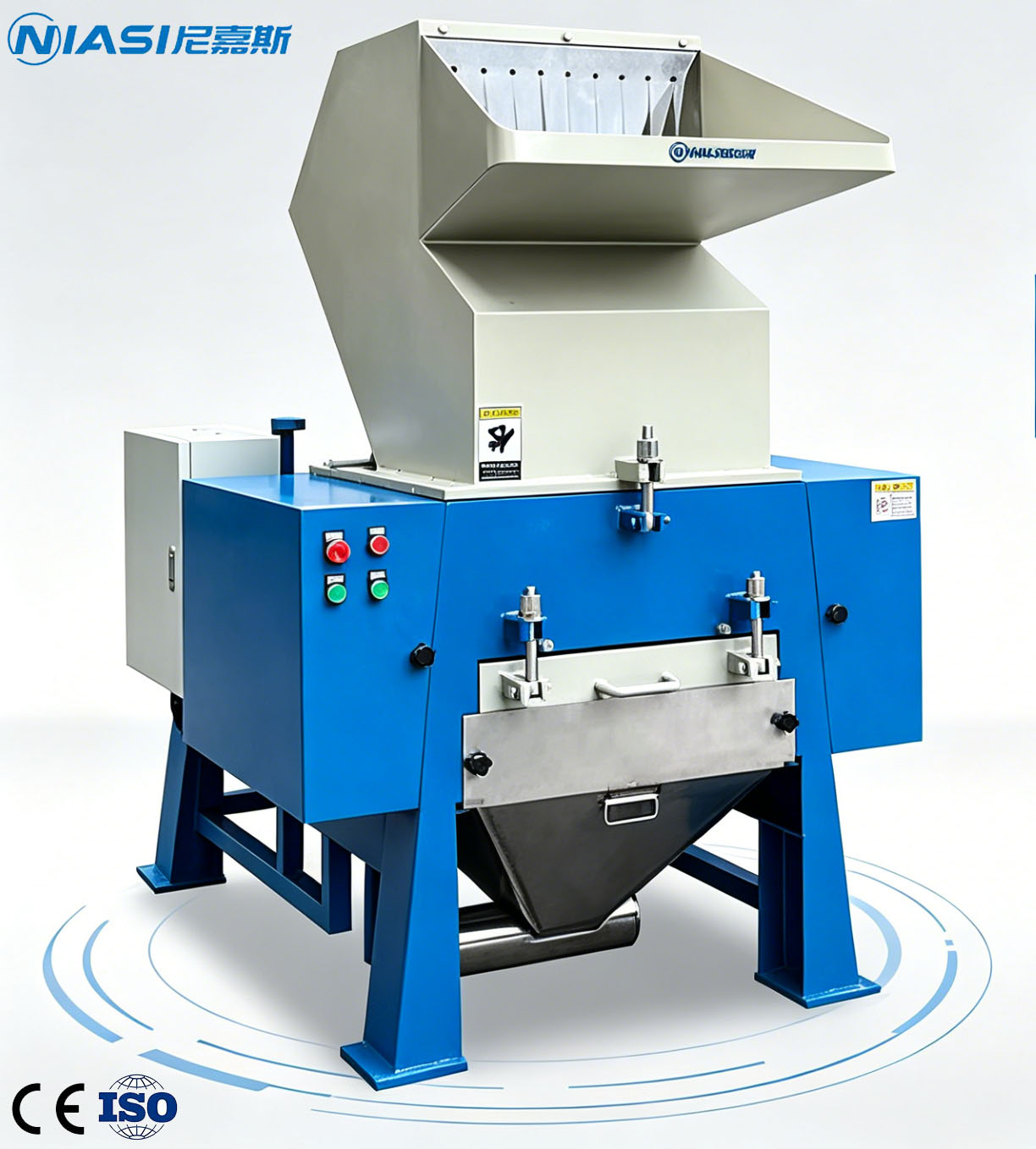
What Is a Plastic Granulator?
A plastic granulator is generally designed to cut plastic scrap into smaller and more uniform flakes or particles. A typical granulation system uses a rotor with cutting knives, stationary knives, and a screen that helps determine the approximate output size.
Granulators are commonly used for clean post-industrial plastic scrap, including injection molding runners, sprues, rejected parts, sheet edges, and other production waste. The processed material can then be collected as regrind for further handling or potential reuse, depending on the polymer, contamination level, and production requirements.
Because equipment terminology varies between manufacturers, “crusher” and “granulator” should not be treated as universal technical classifications. The actual machine configuration and specifications are more useful when comparing equipment.
Plastic Crusher vs. Plastic Granulator: Key Differences
| Comparison Factor | Plastic Crusher | Plastic Granulator |
|---|---|---|
| Primary purpose | Reduce larger or bulky plastic scrap into smaller pieces | Cut plastic scrap into smaller, more consistent flakes or particles |
| Typical feed | Large, irregular, thick, or bulky plastic waste | Production scrap and plastic pieces suitable for controlled cutting |
| Output | Crushed or cut plastic pieces | Relatively uniform flakes or regrind |
| Size control | Depends on cutting chamber and machine configuration | Often controlled by screen aperture and knife configuration |
| Common application | Primary size reduction and scrap processing | Production scrap recycling and controlled size reduction |
| System integration | Can be integrated into collection and recycling systems | Can be integrated into recycling, conveying, storage, and material reuse systems |
Is a Plastic Crusher the Same as a Plastic Granulator?
Not necessarily. Both machines perform plastic size reduction, but their configurations and intended operating conditions can be different.
A crusher is often associated with the initial reduction of larger plastic waste, while a granulator is commonly used when a smaller and more controlled particle size is required. However, these descriptions are not absolute. Some manufacturers use the terms differently, and certain machines can perform functions associated with both categories.
When evaluating equipment, specifications such as rotor design, knife configuration, screen size, feeding opening, motor power, throughput, and material compatibility provide a more reliable basis for comparison than the product name alone.
What Types of Plastic Scrap Can Be Processed?
The suitable material depends on the machine configuration and cutting system. Common examples of post-industrial plastic scrap include:
- Injection molding runners and sprues
- Rejected injection molded parts
- Plastic containers and packaging components
- Plastic sheets and edge trim
- Plastic pipes and profiles
- Production offcuts
- Rigid plastic components
- Selected clean manufacturing scrap
Different polymers can behave differently during size reduction. Material hardness, toughness, thickness, shape, moisture, contamination, and the presence of fillers or reinforcement should therefore be considered before selecting a machine.
Why Is Plastic Scrap Size Reduction Important?
Plastic processing generates scrap at different stages of manufacturing. Injection molding, for example, can produce runners, sprues, rejected parts, and start-up waste. Extrusion and other processes may generate edge trim, offcuts, or out-of-specification material.
Reducing this scrap to a manageable size can simplify collection and transportation while preparing the material for subsequent processing. When the scrap is clean and compatible with the production process, it may be processed into regrind and potentially returned to manufacturing.
The actual reuse ratio depends on factors such as polymer type, product specifications, contamination, thermal history, and the quality requirements of the final product. For this reason, scrap size reduction is one part of a recycling process rather than a complete recycling solution by itself.
How Does a Plastic Scrap Recycling Process Work?
A basic post-industrial scrap recycling process may follow several stages:
Plastic Processing → Scrap Collection → Size Reduction → Material Separation or Screening → Storage → Blending → Reuse
The exact process depends on the type of scrap and the intended application. Some production lines may require only size reduction and collection, while others may incorporate drying, conveying, weighing, blending, or additional separation equipment.
In a factory with multiple injection molding machines, for example, scrap can be collected from different production points and transferred to a centralized recycling or material-handling system. This approach can reduce manual material movement and make production scrap easier to manage.
How to Choose Between a Plastic Crusher and a Granulator
1. Evaluate the Size of the Incoming Scrap
The dimensions of the material are one of the first factors to consider. Large molded parts, thick profiles, pipes, and bulky components may require a larger feeding opening or a machine designed specifically for coarse size reduction.
2. Check the Plastic Material
Different polymers have different cutting characteristics. Before selecting equipment, identify the material being processed and whether it is rigid, flexible, brittle, tough, filled, or reinforced.
Glass-fiber-reinforced plastics and other abrasive materials can place greater demands on cutting components, so the knife material and machine configuration may need to be considered separately.
3. Define the Required Output Size
The required particle size should be determined by the next stage of the process. Screen aperture, knife configuration, rotor design, and cutting clearance can all affect the final material size.
If the processed material will be conveyed, blended, dried, or returned to an injection molding process, the output requirements of those downstream systems should also be considered.
4. Match the Processing Capacity
Machine throughput should correspond to the amount of scrap generated by the production line. Capacity should be evaluated according to the actual material, feed size, operating conditions, and required output rather than relying only on a nominal capacity figure.
5. Consider the Feeding and Collection Method
For small-scale or intermittent production, manual feeding may be sufficient. Larger manufacturing operations may benefit from automated feeding, conveyors, collection bins, or integration with centralized material-handling equipment.
The layout of the production floor should also be considered because the position of the size-reduction machine can affect material flow and operator access.
6. Consider Maintenance Requirements
Knives, screens, bearings, and other wear components require periodic inspection and maintenance. Easy access to the cutting chamber and convenient knife adjustment can simplify routine service.
Maintenance requirements should be evaluated together with the material being processed, operating hours, contamination level, and expected production load.
When Is a Crusher More Suitable?
A crusher can be considered when the production process generates relatively large, bulky, or irregular plastic waste that needs to be reduced before further handling or recycling.
Typical examples include large molded components, thick plastic pieces, pipes, profiles, conta